Water From Air Guide · Updated November 2026
How Can I Turn Humidity Into Drinking Water? 6 Methods That Actually Work
Step outside on a sticky summer morning and feel the air cling to your skin. That heavy, damp feeling? It is water. Billions of tiny drops of it, floating right in front of you. Now imagine if you could catch some of it and pour it into a glass.
It sounds like science fiction, but it is not. People have been pulling water out of the air for centuries, and today there are simple DIY tricks, giant fog nets and home machines that do exactly that. The big question is: how can you turn humidity into drinking water at home, safely, and without wasting money?
In this guide, we explain the simple science, show you six real methods, compare how much water each one makes, and walk you through how to make the water safe to drink. By the end, you will know which method fits your home, your climate and your budget.
Quick Answer
You turn humidity into drinking water by cooling air below its dew point so the water vapor condenses into liquid, then collecting, filtering and disinfecting that water. You can do it with a cold surface, a fog net, a commercial atmospheric water generator (AWG) or a DIY-built water generator. Your results depend mostly on humidity, temperature and power.
| Method | Typical output | Best for |
|---|---|---|
| Cold surface condensation | A few drops to a few spoonfuls | Learning and emergencies |
| Dew collector | Small, overnight only | Survival backup |
| Fog net | Liters per square meter on foggy days | Foggy coasts and mountains |
| Dehumidifier | Liters per day | Not for drinking |
| Commercial AWG | About 1–20 liters a day for home units | Plug-and-play homes |
| DIY water generator | Depends on your build and climate | Budget, off-grid, preppers |
The Simple Science: How Water Comes Out Of Thin Air
Here is something most people never think about. The sky above you is holding an ocean you cannot see. Scientists estimate that about 13 sextillion liters of water exist in the atmosphere at any given time [1]. That is a 13 followed by 21 zeros.
So how do you get it out? The secret is temperature. Warm air can hold more water vapor than cold air. When you cool air down to a certain point, called the dew point, it can't hold all its moisture anymore. The extra vapor turns into liquid drops.
You have already seen this a hundred times:
- Drops forming on a cold glass of iced tea
- Dew on the grass in the early morning
- Water dripping from an air conditioner
- Fog on your bathroom mirror after a hot shower
Every method in this guide uses the same idea, either cooling air until it lets go of its water, or catching tiny drops that are already floating in fog. Once you understand that, the whole thing stops feeling like magic and starts feeling like something you can actually do.
Try it now: put a cold can or glass of ice water on the table and watch the outside. In a few minutes, you are making water from air.
Before You Start: Will It Work Where You Live?
This is the part most "water from air" ads skip. And it is the part that decides whether you will be happy or frustrated.
Two things control how much water you can pull from the air: relative humidity and air temperature. Warm, humid air is full of water. Cold, dry air has very little.
Real-world testing shows how big the difference is. A year-long study of a commercial water-from-air machine in the hot, humid United Arab Emirates found that its ideal conditions were about 22°C (72°F) and 63% relative humidity. In cooler January weather, the same machine dropped to just 0.13 liters per hour and used much more electricity for every liter [2].
A U.S. study that mapped water-from-air machines across the country found the same pattern: dry climates need a lot more energy for each liter of water [3].
So before you spend a dollar, do this:
- Buy a cheap digital hygrometer (a humidity meter) and track your home and yard for a week.
- Note the humidity in the early morning and at night, when it is usually highest.
- If your air is often warm and humid, you are in a great spot. If it is very dry most of the year, expect much smaller amounts.
Knowing your numbers up front saves you money, time and disappointment.
6 Ways To Turn Humidity Into Drinking Water
Let's go through each method, from the simplest kitchen trick to full home systems. For each one, we cover how it works, how much water you can expect and who it is best for.
Method 1: Cold surface condensation (the kitchen-table method)
How it works: You put a very cold surface in humid air, and water forms on it. A metal bowl filled with ice, set on a clean tray, works as a simple demo. Drops form on the outside and run down into the tray.
How much water: Honestly, not much. Usually a few drops to a few spoonfuls, and you often need ice or a fridge to make the cold surface in the first place.
Best for: Kids' science projects and understanding the idea. It is a great "aha" moment, but it is not a real water supply.
Method 2: Dew collection
How it works: At night, surfaces cool down faster than the air. Dew forms on grass, cars and sheets of plastic. Some people spread a clean plastic sheet or tarp at an angle, so morning dew runs into a container. You can also wipe dew off clean surfaces with a cloth and wring it out.
How much water: Small and unreliable. It depends on clear, calm nights with high humidity.
Best for: Survival situations. It is a useful skill to know, but you should treat any collected water before drinking.
Want to build one yourself? See our step-by-step guide on how to make water from air without electricity.
Method 3: Fog nets (fog harvesting)
How it works: In places with thick, regular fog, large mesh nets catch tiny water drops as the wind pushes fog through them. The drops gather, run down the net and drain into pipes or tanks. No power is needed.
How much water: It can be a lot, in the right place. In Morocco, the women-led group Dar Si Hmad runs one of the world's largest fog harvesting systems. Its 600 square meters of nets capture an average of about 6,300 liters of water a day, enough for more than 400 people [4]. Newer CloudFisher nets have collected between 6 and 22 liters per square meter of mesh per day, depending on the region and season [5].
Best for: Foggy coasts and mountain areas. If you don't get regular fog, this method will not do much for you.
It is a beautiful example of what is possible. Villages that once spent hours walking to distant wells now have water piped closer to home, pulled straight from the clouds.
Method 4: Dehumidifier water (and why you should not drink it)
How it works: A dehumidifier cools air over cold coils, just like a water-from-air machine. Water drips into a tank. So it seems like free drinking water, right?
The problem: Dehumidifier water is not safe to drink. The water itself starts out clean, but it runs over coils and parts that are not made for drinking water, and it sits in a tank where mold and bacteria can grow. Stanford's magazine explains that dehumidifier water can carry biological contaminants and metallic residue, and many dehumidifier makers warn against drinking it in their own manuals [6].
Best for: Watering plants (non-edible ones are safest), flushing toilets or cleaning. Not for drinking or cooking.
This is the number one mistake people make. A dehumidifier and a drinking water generator use similar science, but only one is built with food-safe parts and filtration.
Method 5: Buy a commercial atmospheric water generator
How it works: An atmospheric water generator (AWG) is like a dehumidifier built for drinking water. A fan pulls in air, a cooling system condenses the water, and then the water goes through filters and often UV light before it reaches your glass.
How much water: Home units usually make about 1 to 20 liters a day, while big commercial machines can make 1,000 to more than 10,000 liters a day [2]. Real output is lower when the air is cool or dry.
The catch: Price and power. Commercial home units often cost thousands of dollars, and they need steady electricity. One research model of these machines found energy use between about 0.36 and 1.15 kWh for every liter, depending on the weather [7].
Best for: People who want a ready-made appliance, live in a humid area and have the budget.
Method 6: Build your own DIY water generator
How it works: You build a smaller version of an AWG yourself. A fan moves air across a cold surface, condensed water drips into a clean, food-safe reservoir, and then you filter and store it. You use parts you can find at hardware stores or online, so you can size the build to your space and budget.
How much water: It depends on your design, your climate and your power source. In warm, humid air, a well-built unit can make a useful backup supply. In dry air, it will make much less.
Best for: Homeowners, preppers, homesteaders and off-grid families who want a low-cost water backup and don't mind a weekend project.
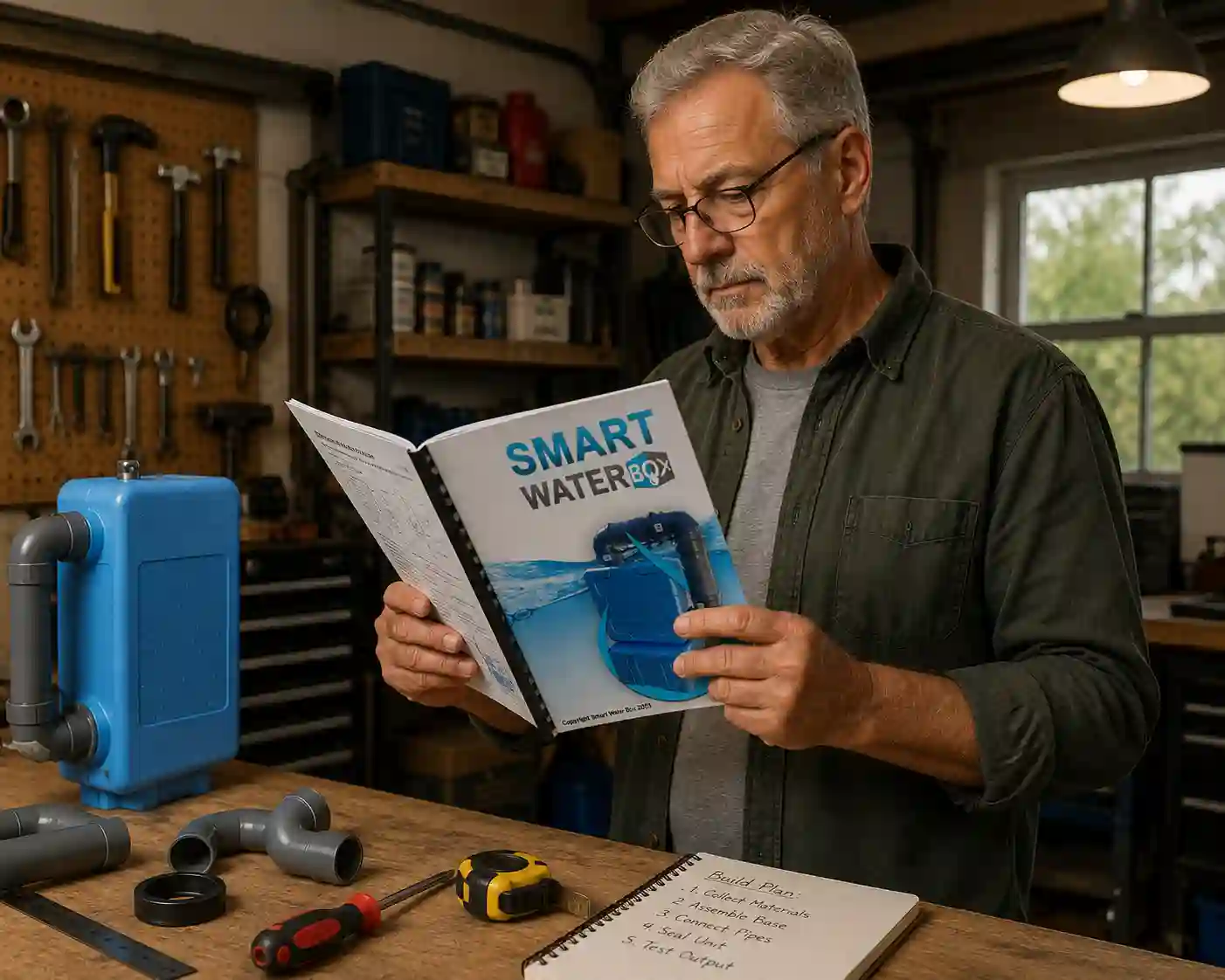
If you like the idea but don't know where to start, a step-by-step plan makes it much easier. The Smart Water Box guide walks beginners through the full build with diagrams, a parts list and filtering steps. We cover it honestly, including its limits, in our Smart Water Box review.
Ready to build your own water-from-air backup? See the Smart Water Box blueprint →
Bonus: The future of water from dry air
What about deserts? Scientists are working on that too. Researchers at UC Berkeley built a harvester using special materials called metal-organic frameworks (MOFs) that soak up water from very dry air. In field tests in California's Mojave Desert, it produced about 0.7 liters of water per kilogram of material per day, and even on a day with just 7% humidity, it still made about 0.2 liters [8].
That is not something you can build in your garage yet. But it shows that water from air is a fast-growing field, and the options will only get better.
Which Method Is Right For You? A Side-By-Side Comparison
| Method | Cost | Power needed | Safe to drink? | Reliability |
|---|---|---|---|---|
| Cold surface | Very low | Ice or fridge | After treatment | Very low |
| Dew collector | Very low | None | After treatment | Low |
| Fog net | Medium | None | After treatment | High in foggy areas only |
| Dehumidifier | Low–medium | Yes | No | Not for drinking |
| Commercial AWG | High | Yes | Yes, built-in filters | Good in humid areas |
| DIY water generator | Low–medium | Yes (grid or solar) | After filtering and treatment | Good in humid areas |
General comparison only. Results depend on your climate, equipment and maintenance.
For most families who want a real backup supply, the choice comes down to two options: buy a commercial machine, or build your own. If budget matters and you enjoy hands-on projects, building your own gives you the most control for the least money.
How To Make Water From Air Safe To Drink
This is the most important section in this whole guide. Please don't skip it.
Water condensed from air starts out very pure, a bit like distilled water. But on its way to your glass, it can pick up dust, pollen, mold spores and germs from the air, plus anything on the surfaces it touches. That is why every method needs a treatment step.
Follow these steps every time:
- Use food-safe materials. Every part the water touches, like the collection surface, tubing and containers, should be food-grade.
- Filter it. A good drinking water filter removes particles and many contaminants.
- Disinfect it. The CDC says boiling is the best way to kill germs in water. Bring it to a rolling boil for 1 minute, or 3 minutes at elevations above 6,500 feet [9].
- Store it clean. Keep water in sealed, clean containers away from sunlight.
- Clean your system often. Wash surfaces and reservoirs regularly to stop mold and bacteria.
- Test it. For long-term use, test your water against local drinking-water standards. The World Health Organization's drinking water guidelines are a helpful reference [10].
Some people also add minerals back to condensed water for taste, since very pure water can taste flat. That is a personal choice, not a safety step.
Remember: clean water is healthy water. Curious why it matters so much? Read our guide to the 20 health benefits of drinking water.
How Much Does It Cost To Make Water From Air?
Every powered method uses electricity, so here is a simple way to estimate your cost.
Research on cooling-based water generators puts energy use at roughly 0.36 to 1.15 kWh per liter, with lower numbers in warm, humid weather and higher numbers when it is cool or dry [7]. To estimate your cost, multiply that by your electricity rate.
For example, if your power costs 15 cents per kWh and your unit uses 0.5 kWh per liter, each liter costs about 7.5 cents. A gallon (about 3.8 liters) would cost roughly 28 to 29 cents. That is often cheaper than bottled water, but more than tap water.
Want to cut the cost? Pair your system with solar panels. The sun does the work, and your water becomes close to free once the panels are paid off. Researchers studying these machines also point out that renewable power can make water from air much more cost-effective [2].
Common Mistakes To Avoid
- Drinking dehumidifier water. It is not made for drinking. Use it for plants or cleaning instead.
- Believing "unlimited water" claims. Any device's output depends on humidity, temperature and power. Be careful of fixed daily promises.
- Skipping filtration and disinfection. Always treat your water, no matter how clear it looks.
- Using non-food-grade parts. Plastic buckets and tubing not made for drinking water can leach chemicals.
- Forgetting maintenance. A dirty reservoir can grow mold in days.
- Ignoring your climate. Test your humidity before you invest.
Turning Humidity Into Drinking Water: FAQs
Can you really get drinking water from humidity?
Yes. Cooling air below its dew point makes water vapor turn into liquid. With proper filtering and disinfection, that water can be safe to drink.
How much water can I get from the air in a day?
It depends on the method and your climate. Home atmospheric water generators usually make about 1 to 20 liters a day, with more in warm, humid air and less in cool, dry air.
Is water from air safe to drink?
It can be, if it is collected with food-safe parts, filtered, disinfected and stored clean. Dehumidifier water is not safe to drink.
Does making water from air work in dry climates?
Cooling-based methods make much less water in dry air and use more energy per liter. New materials like MOFs can work in very dry air, but they are still mostly in research.
What is the cheapest way to make water from air?
Dew collection and fog nets need no power, but they only work in the right conditions. For a steady home supply, a DIY water generator is usually the lowest-cost powered option.
Can I make water from air during a power outage?
Powered methods need electricity, so you would need solar panels or a battery backup. Dew collection and fog nets work without power.
Final Thoughts: The Water Is Already All Around You
Every day, an invisible ocean drifts through your yard, your kitchen and your bedroom. Most people never give it a second thought. But now you know how to tap into it.
If you only want to see the science in action, a cold glass of water on the table will do. If you live in a foggy place, nets can catch hundreds of liters. And if you want a real, practical backup for your family, a commercial or DIY water generator is the way to go. Whatever you choose, treat your water properly and set realistic expectations based on your climate.
Storms, outages and boil-water notices don't send an invitation. The families who stay calm are the ones who prepared before they needed to. Today is a good day to start.
Build Your Own Water-From-Air Backup
Step-by-step DIY blueprint · Beginner-friendly · 60-day money-back guarantee
Get The Smart Water Box GuideSafety note: This guide is for general information only. Always follow electrical safety rules, use food-grade materials and test your water before relying on it. This page contains affiliate links; read our full Disclaimer.
References
- Fathieh, F. et al. (2018). Practical water production from desert air. Science Advances, 4(6), eaat3198.
- Water News Europe. Opportunities for technology that extracts water from air (summary of a 2022 one-year AWG study in Sharjah, UAE).
- Brenes, A.T. & Chini, C.M. (2023). Temporal and spatial variability of energy intensity for atmospheric water generators. Environmental Research: Infrastructure and Sustainability.
- UN Climate Change (UNFCCC). Women-led Fog Harvesting for a Resilient, Sustainable Ecosystem | Morocco.
- Smithsonian Magazine. This Device Collects Water From Clouds.
- Stanford Magazine (2010). Don't Drink the Water (From Your Dehumidifier).
- MDPI Processes (2025). Evaluation of the Potential of Atmospheric Water Generators to Mitigate Water Scarcity in Northern Chile.
- UC Berkeley News (2019). Water harvester makes it easy to quench your thirst in the desert.
- Centers for Disease Control and Prevention. How to Make Water Safe in an Emergency.
- World Health Organization (2022). Guidelines for Drinking-water Quality, 4th edition incorporating the first and second addenda.